The Ultimate Guide to Smart Home Gym Equipment for 2025

The home gym conversation usually goes one of two ways. Either someone describes a dedicated room with thousands of dollars of equipment and the implication that anything less is not really a home gym, or someone describes a single yoga mat in the corner of a bedroom as if that covers the concept. The useful reality sits between these extremes and has become significantly more interesting in recent years as the technology in fitness equipment has improved from gimmicky to genuinely useful.
I have built and used home gym setups across four different apartments over several years, working with progressively different constraints of space and budget. What I know from that process is which categories of equipment actually improve training outcomes and which categories mostly add cost and complexity without changing what you can achieve.
The Case for Smart Fitness Equipment
The honest argument for spending more on connected fitness equipment is not that the technology is impressive. It is that consistency is the primary determinant of fitness progress, and anything that makes training more likely to happen regularly has genuine value.
Smart equipment addresses consistency in two specific ways. The first is by making the session itself more engaging. A cycling session with metrics updating in real time, with structured intervals that vary intensity, with a leaderboard or coach providing targets, is a different experience from pedalling at a fixed resistance while staring at the wall. The engagement is not universal, many people prefer unstructured training, but for those who find unstructured training easy to cut short or skip entirely, the structure that smart equipment provides changes the equation.
The second is by reducing the friction of starting. A Peloton or connected rowing machine with a curated library of classes available on demand removes the planning overhead of deciding what to do. You open the app, pick a session, and start. This matters more than it sounds on the days when motivation is low and any additional decision-making becomes a reason to skip.
Connected Cardio: Where the Technology is Most Developed
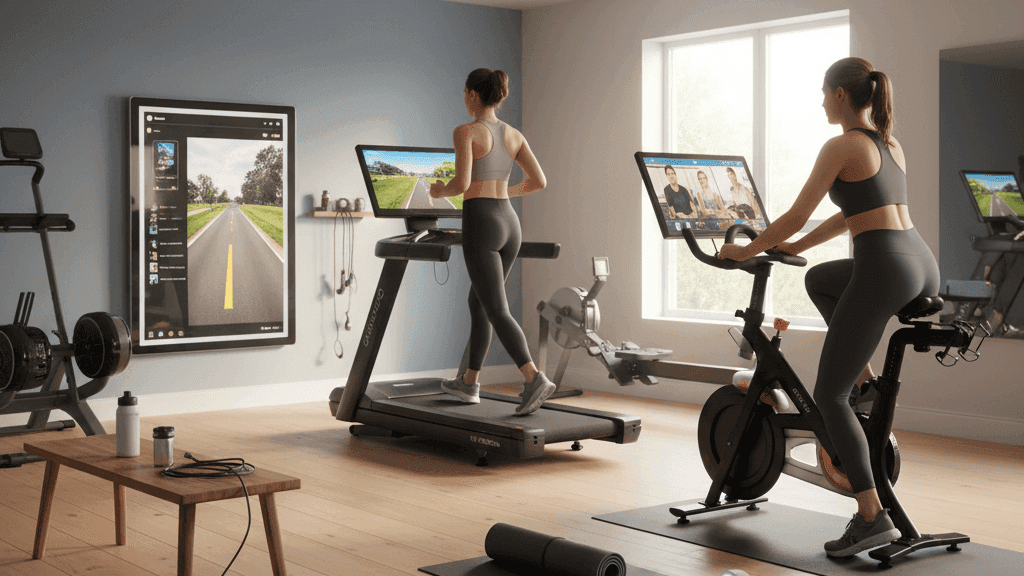
The connected cardio equipment category, primarily cycling, rowing, and running, is where smart fitness technology has the longest track record and the most developed content ecosystems.
Peloton's connected bike remains the benchmark for this category because of the breadth and quality of its class library. The on-demand sessions cover a wide range of duration, intensity, and style, and the instruction quality is consistently high. The metrics displayed during class, cadence, resistance, output, and heart rate on supported monitors, give you real-time feedback that improves training effectiveness by making effort visible rather than subjectively felt.
The honest limitation is cost. The hardware is expensive, the subscription is recurring, and the combination commits you to one platform's content ecosystem. If you stop the subscription, you lose access to the library that justifies much of the hardware's value.
Concept2 rowers represent the alternative philosophy: hardware that is extremely well-regarded among serious athletes, built to last decades, and that logs your metrics through an app without requiring a subscription. The training library is smaller and less polished than Peloton's, but the rower itself is arguably better exercise for full-body conditioning than cycling, and the absence of subscription dependency is a meaningful practical advantage.
For running, smart treadmills with incline and speed that adjust automatically in response to streamed workout instructions, or that follow GPS data to simulate outdoor route profiles, add enough to the experience to justify the premium for people who find treadmill running tedious. For people who genuinely enjoy running and use the treadmill for weather contingencies, the smart features add less.
Strength Training: The Smart Features That Are Genuinely Useful
Smart strength training equipment is more recent and more variable in quality than connected cardio, but some of the underlying technology is genuinely useful rather than just novel.
The Tonal is the most capable wall-mounted strength system currently available. Electromagnetically generated resistance adjusts in fine increments and can switch instantly between different resistance levels, which enables training modalities that are difficult to replicate with free weights: eccentric overload, where you lower more weight than you lift; spotter mode, which automatically reduces resistance if the system detects movement slowing due to fatigue; and variable resistance curves that match the strength curve of specific exercises. These are features with a genuine physiological basis, not marketing language.
The form feedback capability, where the system's sensors and camera detect movement patterns and flag deviations from the intended exercise form, is useful for people learning movements but less necessary for people with established lifting patterns. The automatic weight progression, where the system suggests load increases based on your performance history, handles the programming overhead that many people find it easy to neglect.
The realistic limitation of the Tonal and similar systems is that they do not replace free weight training for people who want to develop the coordination and stabiliser muscle engagement that comes from managing physical weights. They are an excellent substitute for machine-based gym training and particularly well-suited for home environments where the noise and space of free weights would be impractical.
Adjustable smart dumbbells, from brands like PowerBlock and Bowflex, sit in the more accessible tier. The smart features are minimal, mostly app connectivity for workout logging, but the adjustable mechanism solves the real problem of replacing an entire dumbbell rack in a home environment. Being able to switch from light to heavy in seconds rather than walking to a different pair dramatically reduces workout interruption.
Tracking: The Features That Actually Change Behaviour
Fitness tracking technology has the same property as all self-monitoring interventions: it is most useful for people who engage with the data and adjust their behaviour accordingly, and adds little value for people who would rather simply train.
For the first group, a few devices stand out.
The Whoop strap focuses on recovery and readiness rather than activity tracking. It continuously monitors heart rate variability, sleep quality, and other physiological markers to generate a readiness score that tells you whether to train hard, train lightly, or prioritise rest. For people training seriously across multiple disciplines, avoiding overtraining is as important as the training itself, and readiness data helps make those decisions less subjective.
The Oura Ring provides similar recovery and sleep monitoring in a more discreet form factor. The ring format is comfortable enough for most people to wear during sleep without it affecting sleep quality, which matters for any device intended to monitor overnight recovery. The accuracy of its heart rate and HRV measurements matches or exceeds most wrist-based trackers.
Smart scales that measure body composition, not just weight, give you information about muscle and fat distribution changes over time that pure weight tracking misses. Progress in body composition often does not track with scale weight: muscle gain and fat loss can produce no scale weight change while the actual physical change is significant. Withings and Garmin both make scales with reliable body composition estimation at a reasonable price.
Building a Home Gym for a Small Space
The constraint that matters most for most home gym setups is not budget but space. The equipment options that provide the best training-to-footprint ratio are worth knowing specifically.
A pull-up bar that mounts in a doorframe and comes down cleanly when not in use adds one of the most effective upper body exercises without occupying any permanent space. Resistance bands in a full set of resistances store in a bag and handle a surprising range of exercises. A pair of adjustable dumbbells in the PowerBlock or Bowflex format replace a twelve-pair dumbbell rack. These three together cost a fraction of a machine gym and fit in a single wardrobe.
For cardio in small spaces, a folding rowing machine or a compact bike trainer that uses your existing bicycle take up significantly less room than dedicated cardio machines when not in use. Neither has the polished connected experience of a Peloton, but both provide excellent training with basic app tracking.
The most important question before any home gym purchase is: will this equipment get used consistently at the level of intensity it is designed for? A rowing machine in a spare room that you pass every day is a different proposition from the same machine in a storage area you have to clear to access. Placement affects usage, and usage affects value, and both affect whether the investment was worthwhile.
My most used training equipment at home is a pull-up bar, adjustable dumbbells, and resistance bands. Everything else I have tried has seen progressively less use as novelty wore off. The things I actually use are the things that are immediately accessible and that require no setup time before training.


