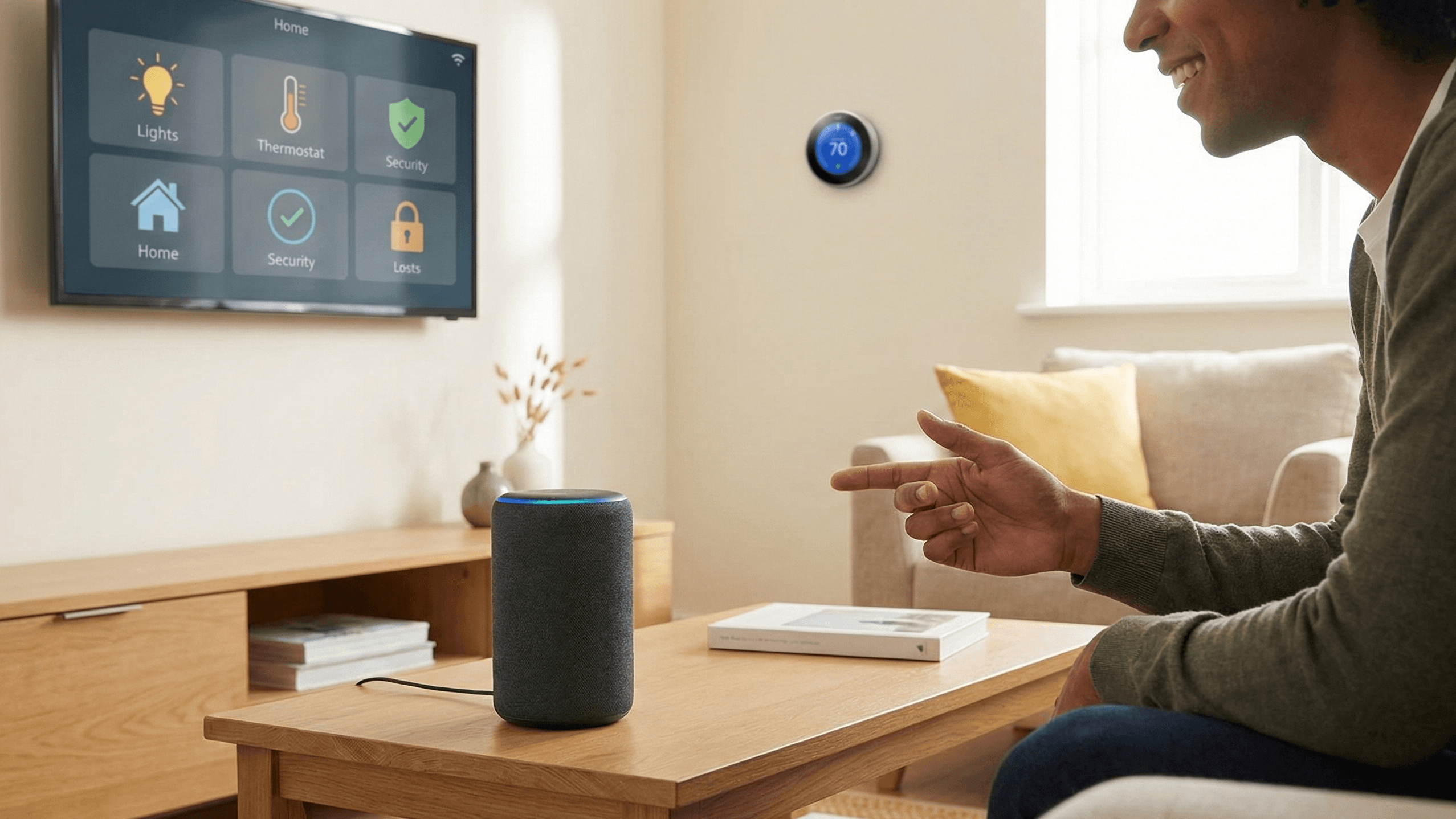
The Future of Voice Assistants in Smart Homes

I have had an Amazon Echo Dot in my apartment for about four years. In those four years I have asked it to turn lights on and off, set timers while cooking, play music, tell me the weather, and occasionally answer questions when I am too lazy to pick up my phone. That is roughly ninety percent of my actual use. The other ten percent is triggering routines, checking whether specific devices are on, and the occasional calculation.
This is not a criticism of the technology. It is an honest description of what voice assistants actually do in most real smart home setups. The gap between how voice assistants are marketed, as intuitive conversational partners that anticipate your needs and coordinate your entire home intelligently, and how most people actually use them, as reliable voice-controlled switches with some conversational capability, has been a persistent feature of this category.
Understanding where that gap currently stands, and where it is genuinely narrowing versus where it is mostly marketing, is the most useful frame for thinking about voice assistants in smart homes right now.
What Voice Assistants Are Actually Good at Today
The core smart home control use case is genuinely well served by current voice assistants, and it is worth appreciating this before discussing what they cannot yet do reliably.
Turning devices on and off by voice, triggering named routines and scenes, checking the status of specific devices, and setting schedules through conversation are all things that Alexa and Google Assistant handle with high reliability. These interactions work in the first attempt the vast majority of the time, respond within a second or two, and require no learning period. This is not trivial: the reliability of these basic interactions is what makes voice control actually useful in daily life rather than just impressive in demonstrations.
The routine-building capability in both Alexa and Google Home has matured to the point where you can create reasonably complex automations through conversation or through straightforward app interfaces without technical knowledge. Telling Alexa to add a new step to an existing routine by voice, or asking Google to create a simple morning routine, works consistently.
Music and general assistant tasks work well and are genuinely convenient in a kitchen or bathroom context where touching a phone is inconvenient. Timer management while cooking is arguably the most universally appreciated voice assistant feature and the one that converts the most skeptics into regular users.
Where the Gap Between Marketing and Reality Remains
The conversational intelligence that voice assistant marketing emphasises most heavily is the area with the largest gap between the pitch and the practical reality.
Natural language processing has improved substantially. Both Alexa and Google Assistant handle varied phrasing for smart home commands more reliably than they did three years ago. You no longer need to phrase commands in precisely the right way to have them understood. But the intuitive conversation that promotional material implies, where you describe what you want in natural language and the assistant figures out the best way to achieve it across your specific devices, is not reliably available in everyday use.
Follow-up questions and multi-turn interactions work in specific supported contexts but fail in others in ways that are difficult to predict. Contextual awareness that carries information from one part of a conversation to another is inconsistent. The experience of trying to coordinate a complex request and having the assistant misunderstand the second step after correctly handling the first is a common frustration that has not been fully resolved.
The platform differences matter here. Google Assistant handles complex conversational requests better than Alexa in my experience, drawing on Google's search and knowledge capabilities to provide more accurate and detailed responses to factual questions. Alexa handles smart home device compatibility more broadly and its routine system is more flexible for complex home automations. Neither is clearly superior across all use cases.
Siri through Apple HomePod is notably behind both in smart home device compatibility and in handling requests that go beyond the Apple ecosystem, but it integrates more deeply with Apple services and devices for households that are fully in that ecosystem.
The AI Improvements That Are Genuinely Happening
The large language model improvements that have transformed how AI assistants handle open-ended conversation are being incorporated into smart home voice assistant products, and the improvements are real even if the marketing around them is predictably exaggerated.
The most practical improvement is in handling ambiguous or incompletely specified requests. Earlier voice assistant systems required fairly precise command structures. Current systems are better at interpreting what you probably meant when your phrasing is unusual or incomplete, and at asking a useful clarifying question rather than simply failing and returning an error.
On-device processing for common requests is improving, which reduces latency and makes voice control feel more responsive. For the most frequently used commands in a specific household, some systems are beginning to handle processing locally rather than routing through cloud servers, which also addresses some privacy concerns.
The integration of voice assistants with larger AI models for general knowledge questions has made the general assistant capability of these devices significantly more useful, though this is more relevant for the question-answering use case than for smart home control.
Privacy: Still a Real Consideration
Voice assistants require a device that is always listening for a wake word. That is the fundamental architecture of the technology and it creates a genuine privacy consideration that does not disappear because the major brands have implemented protections around it.
All three major platforms allow you to review your voice interaction history and delete it. All three have implemented controls around what is recorded and stored. Apple processes more interactions on-device than the other platforms, which means less audio is transmitted to servers.
The practical recommendation is to treat voice assistant placement with some care. Putting an Echo Dot or Nest Mini in a living room or kitchen where household activity is mostly routine and non-sensitive is different from placing one in a bedroom or home office where private conversations are more likely. This is not paranoia; it is a reasonable response to the actual architecture of the technology.
Muting the microphone when you do not need the voice assistant is an option all devices provide. It is worth using during sensitive conversations rather than assuming the wake word detection is perfectly reliable in all conditions.
What Will Actually Change Over the Next Few Years
The improvements in voice assistant technology that will matter most for smart home users are likely to come from better reliability and broader device support rather than from more sophisticated conversation.
The reliability of basic interactions is already high but not perfect. Missed wake words, misheard commands, and automation failures that occur for unclear reasons are still frequent enough to be occasionally frustrating in regular use. Reducing these friction points matters more for the daily experience of using a smart home than adding sophisticated new capabilities that most people will use rarely.
The Matter standard's continued expansion will reduce the platform lock-in that currently means choosing a voice assistant ecosystem also means limiting your device choices. As more device categories become genuinely cross-platform, the choice of voice assistant will become more about the quality of the conversational experience and less about which devices it can control.
The AI improvements in understanding natural language are likely to continue making it possible to control your smart home through more casual, conversational commands rather than specific phrasings. This is genuinely useful and represents a real reduction in the learning curve for new users.
What is unlikely to change as quickly as the marketing suggests is the proactive, anticipatory intelligence that the most ambitious vision of smart home voice assistants describes. A home that learns enough about your patterns to take meaningful action without being asked is technically achievable in limited contexts but requires the kind of sustained attention and fine-tuning that most households are not going to invest. The practical smart home for most people will continue to be one where you configure specific automations and the voice assistant executes them reliably, not one where the assistant figures out what you need without being told.
That is a more modest vision than the marketing implies, but it is also genuinely useful, and the technology that delivers it reliably is worth having.
Four years of daily voice assistant use has convinced me that the technology's value is in reliable execution of things you explicitly configure, not in autonomous intelligence. Expecting the former gives you a useful tool. Expecting the latter leads to frustration.


