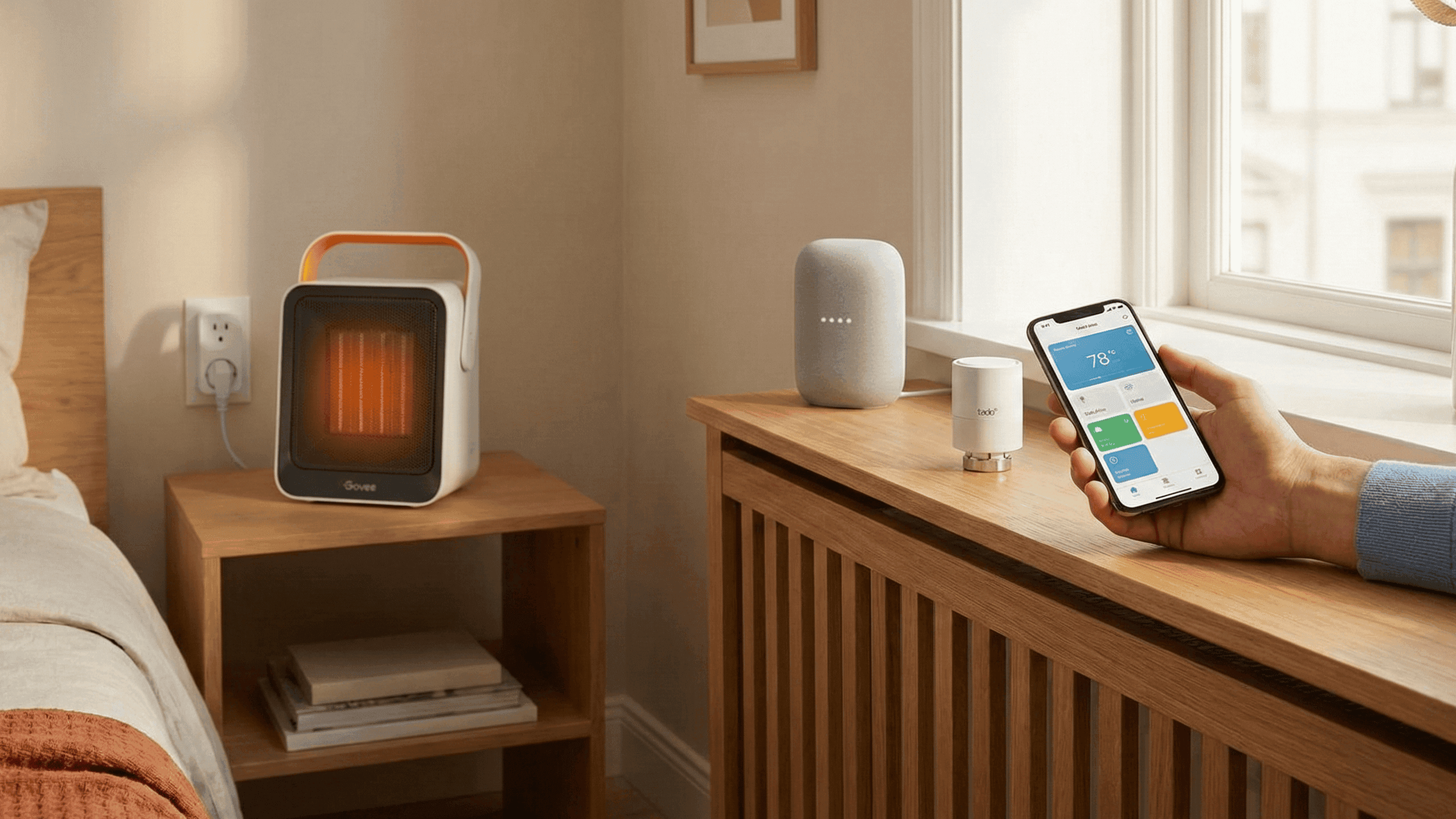
Smart Thermostat Alternatives When You Don’t Control the Building Heating

I lived in a building for two years where the heating was controlled centrally. The corridor thermostat was inside a locked plastic box. The radiators ran on the building's schedule, which was set by someone who apparently believed that humans are comfortable at temperatures that would make a greenhouse nervous. My options, as presented to me, were: be too hot, open a window and lose all the heat, or move out.
What I actually did was build a surprisingly effective room-level climate control system using four devices that cost about $120 combined and required zero permission from my landlord. None of them touched the building's heating system. All of them made my apartment noticeably more comfortable throughout the year.
If you rent, live in a managed building, or otherwise cannot install a smart thermostat on the boiler, this is the guide for your situation specifically.
Why the Standard Smart Thermostat Advice Does Not Apply Here
Most smart home guides assume you have a boiler or HVAC system with a thermostat that you can replace. The Nest, the Ecobee, the Hive: all of these require wiring access to your heating system and permission to modify it. In a rented apartment or any building with shared heating infrastructure, that access does not exist.
The mental shift that made this problem solvable for me was stopping thinking about controlling the heat source and starting thinking about controlling the room. The building produces heat. What I can control is how much of that heat enters my specific space, how that heat is distributed within my space, and how I supplement or counteract it depending on whether the building is giving me too much or too little.
That reframe leads to a set of tools that work regardless of what is happening in the boiler room.
Smart Radiator Valves: The Closest Thing to a Real Thermostat
If your apartment has individual radiators with manual control knobs, smart radiator valves are the most direct solution and the one I would try first.
A smart radiator valve replaces the manual knob on your radiator with a battery-powered motorised valve that opens and closes based on a target temperature you set. The building still pumps hot water through the pipes according to its own schedule, but the valve determines how much of that water flows through your specific radiator and therefore how much heat enters your room.
The practical result is that you can set your bedroom to 19 degrees at night and 22 degrees in the morning without touching anything. The valve does the adjusting automatically based on its own temperature sensor. You can change targets through an app, set different temperatures for different times of day, and control individual rooms differently from each other if you have valves in multiple rooms.
The Eve Thermo and the Tado Smart Radiator Thermostat are both solid options that have been on the market long enough to have reliable firmware and good app support. Both are designed for renter-friendly installation, typically requiring only a wrench to swap out the existing knob. Most standard radiators use a common valve connection thread, but it is worth checking whether you need an adapter for your specific radiator before buying.
The limitation is that you are working within what the building provides. If the building heating is off, the valve cannot produce heat. You are managing distribution and room-level temperature targets, not overriding the building's schedule entirely.
Smart Plugs With Portable Heaters: Creating Your Own Supplemental Heat
In buildings where the central heating is genuinely inadequate or unpredictable, supplementing with a portable electric heater is common. Combining that heater with a smart plug turns an inconvenient manual process into something much closer to a thermostat experience.
The basic setup is straightforward. Plug the heater into a smart plug. Set the heater's own temperature dial or thermostat to your comfortable maximum, then let the smart plug control when power is supplied to it. The heater runs when the plug is on and stops when the plug is off.
Using a schedule, you can have the heater run for thirty minutes before you wake up in winter, then cut off automatically. Using a timer, you can ensure it never runs for more than a set period regardless of whether you remember to turn it off. Using presence detection, you can have it switch off automatically when your phone leaves the home network, which handles the common anxiety of wondering whether you left it running.
The more sophisticated version uses a separate temperature sensor in the room. Some smart home platforms, particularly Google Home and Home Assistant, allow you to create a rule that switches the smart plug on when the room temperature drops below a threshold and off when it reaches the target. This is effectively a DIY thermostat using off-the-shelf components.
There are safety considerations worth taking seriously. The smart plug must be rated for the heater's wattage with comfortable headroom, not just the minimum. Heaters should not be placed near curtains, bedding, or anything that restricts airflow. And leaving a heater running unattended, even through a smart schedule, is worth thinking carefully about depending on the type of heater.
Panel heaters and oil-filled radiators are safer for timed operation than fan heaters because they do not have exposed heating elements and are less prone to overheating if airflow is accidentally restricted.
Smart IR Controllers for Split AC Systems
If your apartment has a split air conditioning unit that also provides heating in winter, a smart IR controller is one of the most powerful tools in this category because it gives you genuinely sophisticated control over a capable climate system that just happens to have a basic remote.
An IR controller learns the codes from your AC remote and can then reproduce any button press via an app, a voice command, or an automation. Combined with its built-in temperature and humidity sensor, it becomes a proper room thermostat for your AC system.
The Switchbot Hub Mini and the Broadlink RM4 Mini are both reliable and well-supported. Setup is quick: place the device where it has line of sight to your AC unit, run through the learning process for your remote, and within fifteen minutes you have full app and voice control.
From there, you can set schedules that pre-cool the apartment before you arrive home in summer, run the AC in heating mode at a lower temperature than the building provides in shoulder seasons, and automatically switch it off after a set period at night. Combined with the temperature sensor, you can create rules that prevent the AC from running unnecessarily when the room is already at your preferred temperature.
This is the approach I use personally and the comfort improvement compared to the building's central system alone is significant. The AC becomes the primary comfort tool and the building radiators become background infrastructure.
Temperature and Humidity Sensors: Knowing What You Are Working With
Any of the above approaches benefits significantly from having actual temperature readings from the rooms you care about rather than guessing or relying on whatever the building's corridor sensor says.
Small wireless temperature and humidity sensors are inexpensive, run for a year or more on a battery, and give you real data about conditions in specific rooms. The Govee Bluetooth sensors work well for basic monitoring through their own app. Aqara sensors integrate with both Google Home and Apple HomeKit and can be used as triggers in automations.
Knowing the actual temperature in your bedroom at different points in the day tells you which interventions are necessary and which are not. It also lets you build specific rules: if the bedroom temperature drops below 17 degrees in the evening, trigger the heater plug for twenty minutes. If it exceeds 25 degrees, send a notification to open a window. These are simple rules but they respond to actual conditions rather than fixed schedules, which makes them more accurate and less wasteful.
Smart Blinds and Curtains: Using What the Sun Provides
This is the category that people tend to underestimate because it sounds low-tech, but in practice the thermal difference that well-timed blinds make in a room is significant.
In winter, south-facing windows can provide meaningful passive solar heat during daylight hours if the blinds are open to let it in. Closing those same blinds after sunset provides insulation that reduces heat loss through the glass. The swing in room temperature between optimal and non-optimal blind management can be several degrees, which is not trivial when you are trying to supplement an inadequate central heating system.
Smart blinds that open and close on a schedule based on sunrise and sunset, or that can be triggered by temperature sensors, handle this automatically without you having to think about it. IKEA's FYRTUR range and Ikea's partnership with their smart home system makes them one of the most affordable ways to get motorised blinds that work with Alexa and Google Home. SwitchBot also makes retrofit motors that can be attached to existing blind cords, which is a cheaper option if you already have suitable blinds.
Motorised curtains through systems like the SwitchBot Curtain motor are a similar approach for rooms with curtain tracks rather than blinds.
Putting It Together
If I were moving into a building with central heating I could not control, I would set up climate management in this order.
Temperature sensors in the rooms I care about first, because they cost little and give me the information I need to make everything else work well.
A smart plug on any portable heater or fan I already own, with a basic schedule and a maximum runtime safety cutoff.
Smart radiator valves on the radiators in my bedroom and main living area, if the radiators are compatible and I can install them without permission issues.
An IR controller for any AC or heat pump in the apartment, which gives me the most sophisticated and comfortable control of anything on this list.
Smart blinds or a blind motor for windows with significant sun exposure, prioritised by how much difference they are likely to make in practice.
None of this requires touching the building's system. None of it requires landlord permission in most cases. And all of it together genuinely changes how comfortable a home feels to live in, even when the thermostat is locked in a box in the corridor.
Two winters in a building with locked central heating taught me more about room-level climate control than I would have learned in ten years of having a thermostat I could freely adjust.


