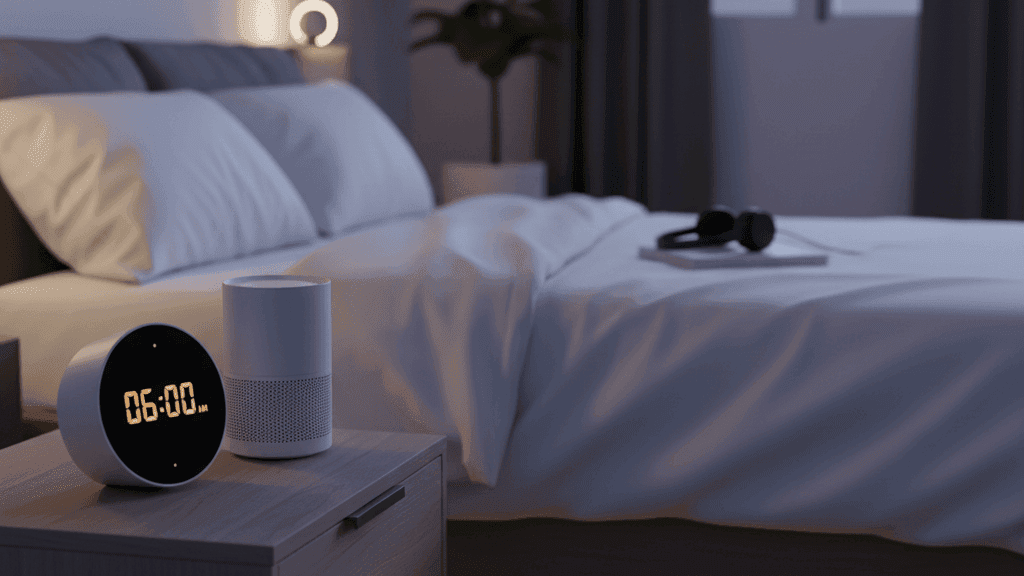
Smart Sleep Gadgets That Actually Help You Rest Better

I was sceptical about sleep technology for a long time, mostly because the marketing around it tends toward vague wellness language that does not tell you what the device actually does or whether it actually helps. "Optimise your recovery." "Unlock deeper sleep." These phrases describe things I want but do not explain the mechanism by which a piece of hardware produces them.
What changed my thinking was spending time with the research behind specific devices rather than the marketing around them. The physiology of sleep is genuinely well-understood. Your core body temperature drops as you fall asleep and rises before you wake. Light suppresses melatonin. Sleep stages have measurable electroencephalogram signatures. Consistent schedules anchor your circadian rhythm. These are not contested facts. The question is whether consumer technology can meaningfully interact with these mechanisms at a price and convenience level that justifies using it.
For some categories, the honest answer is yes. For others, it is more complicated.
Temperature Control: The Category With the Strongest Mechanism
The Eight Sleep Pod is the sleep technology product I would recommend most readily to someone who struggles with temperature during the night, which is a broader category than most people realise.
The cover fits over your existing mattress like a fitted sheet. Inside it, a network of very fine tubes carries water that is precisely temperature-controlled by a unit that sits under the bed. You set your preferred sleep temperature through an app and the system maintains it throughout the night, adjusting in response to changes in your body temperature as you move through sleep stages.
This directly addresses something that has a clear physiological basis. Your body's natural temperature drop at sleep onset is part of the mechanism by which you fall asleep. A sleep environment that is too warm interferes with this by requiring your body to work harder to shed heat. A surface that is actively cooled to your preferred temperature removes that interference. The research on ambient temperature and sleep quality is extensive and consistent.
The practical benefit that gets reported most consistently by people who use the Eight Sleep: faster sleep onset, fewer night-time waking events, and feeling more rested at the same total sleep duration. The AI autopilot feature, which adjusts temperature automatically based on detected sleep stage, adds a layer of optimisation beyond what a fixed temperature setting achieves.
The limitations are real. The cost is significant. The system requires ongoing maintenance of the water circuit. The AI features require a subscription after the initial period. And for partners who share a bed but have different temperature preferences, the dual-zone functionality of the Pod 4 handles this well, but it is still two systems to manage.
For people who wake up in the night sweating, or who find it takes a long time to fall asleep and believe temperature may be a factor, this is the device with the clearest mechanism and the most consistent user reports.
Sleep Tracking: What It Is and Is Not
Sleep trackers produce data about your sleep. The question is whether having that data leads to better sleep, which is more complicated than it initially appears.
The Withings Sleep Analyzer is a thin pad that slides under your mattress and detects heart rate, breathing, and movement through pneumatic pressure sensors without requiring you to wear anything. It classifies your sleep into stages, tracks snoring, and flags breathing patterns that may warrant medical attention, including potential sleep apnea indicators.
The accuracy of consumer sleep trackers has been a subject of ongoing research, and the short version is: they are useful for tracking trends over time and detecting significant departures from normal, but the specific night-by-night sleep stage classifications should not be treated as precise medical data. The Withings analyser performs reasonably well against clinical sleep studies for general sleep quality assessment, but the specific deep sleep versus light sleep percentages on any given night have wider error margins than the confident-looking graphs in the app suggest.
Where sleep tracking delivers consistent value is in revealing patterns you would not otherwise notice. That your sleep quality drops reliably after alcohol consumption. That your sleep is consistently worse on Sunday nights. That your resting heart rate during sleep has been trending upward over three weeks, which sometimes precedes illness. These are patterns that become visible over months of data and would be invisible without it.
The Oura Ring is the wearable alternative that performs well in accuracy comparisons with clinical equipment. It is comfortable enough for most people to sleep in without noticing it, which is genuinely important because a wearable that disrupts sleep by being present is counterproductive. The ring format keeps sensors closer to arterial blood flow in the finger than a wrist-based watch, which improves measurement quality for heart rate and heart rate variability.
The honest framing for sleep trackers: they are most useful for people who are motivated to make changes based on data and who have specific hypotheses about their sleep to investigate. For people who simply want to sleep better without engaging with data, a tracker may produce anxiety about sleep quality scores rather than improving sleep. Watching your deep sleep percentage drop after a stressful day is not necessarily more useful than simply knowing you did not sleep well.
Sunrise Alarm Clocks: A Clear and Immediate Benefit
The sunrise alarm clock is the sleep technology category with the most straightforward mechanism and the highest rate of immediate benefit for people who try it.
Your body has photoreceptors in the eyes that respond to light by suppressing melatonin and initiating the hormonal cascade that produces wakefulness. A conventional alarm clock produces a sudden auditory shock that interrupts sleep without engaging this mechanism. A sunrise alarm clock gradually increases light intensity over twenty to thirty minutes before your set wake time, giving your body time to transition out of deeper sleep stages naturally.
The Philips Wake-Up Light HF3520 is the most established and most consistently recommended product in this category. It reaches 300 lux at full brightness, which is sufficient to produce the physiological waking response when positioned correctly on a nightstand. The light transitions from a red-warm tone at onset to a bright neutral white at full intensity, mimicking the colour temperature shift of actual sunrise.
People who describe themselves as extremely difficult to wake, who sleep through multiple alarms, who feel genuinely terrible for the first hour of every morning: these are the people for whom sunrise alarms most consistently make a material difference. The mechanism is well-established enough that the product works as described when used correctly.
The one design requirement worth taking seriously: proximity matters. A sunrise alarm clock on the far side of a large room will not produce the intended effect. It needs to be close to where you sleep, close enough that the brightening is clearly visible without opening your eyes fully.
For people who already have smart bulbs, a wake-up routine that gradually increases brightness using a lamp on the bedside table achieves a similar effect. The dedicated device does it more precisely and with better light quality, but the smart bulb alternative is worth trying before buying dedicated hardware.
Sound for Sleep: What Actually Works
Background sound for sleep is one of the more researched areas of sleep hygiene, and the consistent finding is that continuous, unchanging sound masks the intermittent sounds that most commonly disrupt sleep, particularly sounds that start and stop or occur irregularly.
White noise, pink noise, and brown noise all achieve this to varying degrees. The differences between them are in their frequency distribution: white noise has equal energy across all frequencies, which sounds like television static; pink noise drops off at higher frequencies, which sounds more like rain; brown noise drops off more steeply, which produces a deeper rumble. Many people find the lower-frequency options more comfortable for extended listening.
Smart sound machines like the Hatch Restore add a schedule and routine framework around this basic function. The Restore 3 specifically allows you to create bedtime routines where a sound starts automatically at a set time, gradually dims with your lights, and transitions to silence after a set period. The morning routine reverses this with a sunrise and a gentle sound that increases in volume. For people who find the transition to sleep and wake easier with consistent environmental cues, this automated routine is genuinely useful.
The subscription that Hatch uses to lock some of its content behind a paywall is worth noting. The core functionality of sound playback and scheduling works without a subscription. The guided sleep content and exclusive audio programmes require one. If the guided content is something you will actually use, the subscription adds value. If you want a smart sound machine with good scheduling, the subscription is optional.
The Fundamentals Still Matter More
Every piece of sleep technology I have described works best as a complement to, not a replacement for, the environmental and behavioural factors that most consistently affect sleep quality.
A dark room. A consistently cool temperature. A reasonably consistent sleep and wake time. Not using bright screens immediately before sleep. These interventions have stronger evidence bases than most consumer sleep technology and cost nothing or close to nothing to implement.
Blackout curtains in a room that receives morning light, a fan to reduce room temperature and provide background sound, and a consistent schedule address the most common sleep disruptors for most people. Starting with these before buying technology is the sensible sequence.
Where the technology earns its place: once the basics are addressed and sleep is still poor, specific products like the temperature-controlling cover for people who run hot, the sunrise alarm for difficult wakers, and the under-mattress tracker for people investigating specific patterns, add targeted interventions with good mechanisms and reasonable evidence.
After testing several of these products, the sunrise alarm is the one I would recommend to the widest range of people as a first purchase. The mechanism is clear, the result is immediate, and the cost is low relative to the benefit for people who struggle with mornings.


