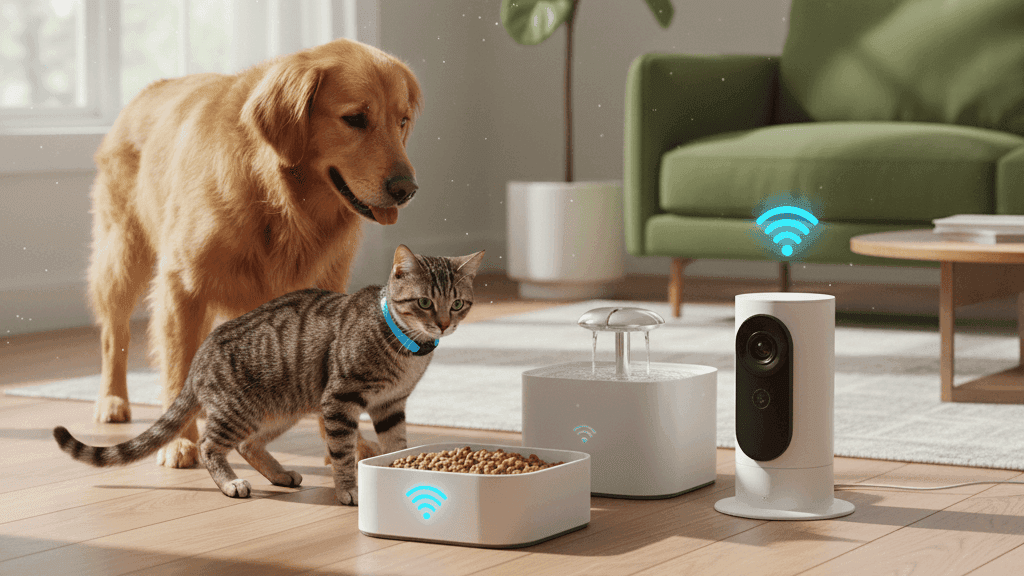
Connected Pets: The Ultimate Guide to Smart Pet Tech for 2025

I got my first pet as an adult and immediately discovered a category of low-grade anxiety I had not previously experienced: the background wondering about what was happening at home while I was out. Was she eating? Was she anxious? Had she knocked something over? The not-knowing was its own problem, separate from anything actually going wrong.
Smart pet technology exists primarily to address exactly this. Not all of it does so usefully, and the category has enough gimmicky products to make scepticism reasonable. But a genuine subset of connected pet devices makes a meaningful practical difference to how pets are managed and how owners feel about leaving them. This is the honest version of what actually works and what is more marketing than substance.
Pet Cameras: Remote Presence That Actually Helps
A camera in the room where your pet spends most of their time is the single most immediately useful piece of pet technology for most owners, because it transforms a wondering into an answer. Not knowing what is happening is stressful. Being able to look and see your cat asleep on the sofa, or your dog lying contentedly by the window, resolves the uncertainty and lets you move on.
The Furbo and Petcube cameras have been in this space long enough to have established reliability records and wide user bases. Both offer 1080p video with two-way audio, treat dispensing triggered through the app, and motion and sound alerts. The two-way audio is more useful than it initially sounds: being able to speak to a dog through the camera and have them respond to your voice can interrupt an anxiety spiral, and some owners report that regular check-in "calls" significantly reduce separation anxiety behaviour in dogs.
The pet-specific features that distinguish these from generic security cameras are the treat dispenser integration and the motion alert sensitivity tuned for animal movement patterns. A generic security camera set to motion sensitivity appropriate for intruder detection will also alert constantly when a cat moves around a room. Pet cameras can be tuned to alert for sustained unusual movement rather than any motion.
For the camera to be genuinely useful, placement matters. It should be at a height and angle that covers where the pet actually spends time, not just an overview of the room. A camera aimed at the sofa in a room where the dog consistently rests gives you useful information. A camera showing an empty room occasionally tells you the dog has left that room.
Automated Feeders: The Use Case Is Specific but Real
Automated pet feeders address a specific set of situations: households where feeding times are genuinely inconsistent due to varying schedules, situations where an owner travels and someone else is managing feeding, and cats or dogs who would benefit from smaller more frequent meals rather than one or two large ones.
The PetSafe Smart Feed and the Sure Petcare range handle scheduling reliably and send notifications when feeds are delivered. For multi-pet households where one pet tends to eat more than their share, the Sure Petcare microchip feeders identify individual pets and only open for the registered animal, which solves a common problem with multiple-pet households.
The realistic limitations: automated feeders do not replace the human interaction that feeding provides in terms of routine, bonding, and the opportunity to observe your pet's daily behaviour. A dog or cat that eats enthusiastically on Monday but barely touches food on Tuesday is telling you something about how they are feeling. An automated feeder dispenses the meal without that observation happening. For pets with health conditions where appetite is a meaningful indicator, this is worth considering.
Smart water fountains, which circulate water to keep it fresh and oxygenated rather than sitting stagnant in a bowl, address a genuine feline preference: many cats drink more from moving water than still water, which is relevant for urinary tract health. The Catit and Petlibro fountains both perform well in this regard.
GPS Collars: Meaningful Peace of Mind for Outdoor Pets
For dogs that spend time outdoors or cats that go outside, a GPS tracking collar changes the experience of the pet not being immediately visible from anxious uncertainty to specific knowledge.
The Tractive GPS tracker is the most widely used option with a strong track record of reliable location updates. It connects to cellular networks rather than your home Wi-Fi, which means it works wherever there is mobile coverage rather than only within Bluetooth range. You set a geofence around your home through the app, and receive a notification when your pet leaves that area.
The honest limitations: GPS requires a subscription for cellular connectivity, the accuracy is typically within a few metres rather than pinpoint precision, and battery life requires regular charging. The battery issue is the most practically significant, as a collar that is not charged is useless in exactly the situation where you need it.
For outdoor cats specifically, the activity monitoring some GPS collars provide is a secondary benefit worth knowing about. Cats that significantly reduce their usual movement pattern, or that spend unusual amounts of time in one location, are sometimes displaying early signs of illness or injury. Having data about normal activity patterns makes departures from normal more visible.
Health and Activity Trackers: Useful Over Time, Not Day-to-Day
Wearable health trackers for pets, products like FitBark and the PetPace collar, collect data on movement, sleep, and in some cases heart rate and respiratory rate. The value of this data is primarily longitudinal rather than immediate: what matters is not what your dog's resting heart rate is today but whether it has changed significantly over weeks or months.
Vets who work with patients whose owners use these devices report that the historical data is genuinely useful for assessing whether reported symptoms are recent or long-standing, and for monitoring recovery from illness or surgery. The baseline that a months-long data history provides is different from the snapshot that a vet visit provides.
For most healthy pets with attentive owners who notice behavioural changes, the day-to-day utility of health tracking data is limited. The value proposition is strongest for senior pets, pets with chronic conditions being managed over time, and pets whose owners are specifically monitoring for recurrence of past health issues.
Automatic Litter Boxes: The High-Cost Item With Genuine Quality-of-Life Impact
Self-cleaning litter boxes occupy the most expensive tier of everyday pet technology and consistently attract the most polarised reviews: either owners find them transformative or they find them an expensive source of mechanical problems.
The PETKIT Purobot Ultra and the Litter-Robot series are the most established options with the longest track records. Both use rotation to separate waste from clean litter, depositing waste into a sealed compartment that contains odours and reduces how often you need to interact with the box. The frequency and reliability of cleaning cycles, along with the effectiveness of odour containment, are the practical factors that determine whether these devices are worth their cost.
The health monitoring feature that some advanced models include, tracking frequency of litter box use and flagging unusual patterns, is a genuinely useful addition because changes in litter box behaviour are one of the more reliable early indicators of health issues in cats, particularly urinary problems.
The realistic expectation: a self-cleaning litter box does not eliminate maintenance. It reduces the frequency of scooping and significantly reduces odour. The waste compartment still needs to be emptied regularly. Mechanical failures do occur, though less commonly in the established premium brands than in cheaper alternatives.
What to Prioritise When Building a Connected Pet Setup
The devices that deliver the most consistent value across different owner situations are the camera and the GPS tracker for outdoor pets. These address the most universal pet-owner concerns, persistent and immediate, rather than specific scenarios. Start with these before considering feeding automation, health tracking, or cleaning systems.
Feeding automation makes the most sense for owners with genuinely inconsistent schedules who cannot rely on being home at regular feeding times, or for multi-pet households where food competition is a problem. For owners with consistent schedules and single pets, an automated feeder adds cost and maintenance without changing much.
Health tracking adds the most value for senior pets and pets with known health conditions. For healthy young animals with attentive owners, the marginal benefit of data tracking is real but smaller.
The self-cleaning litter box is a genuine quality-of-life upgrade that is worth the cost for anyone who finds litter maintenance a significant chore, but is not a necessity. The payoff is most clear for multi-cat households where manual scooping frequency is highest.
The pet camera is the device I would recommend first to any new pet owner. The ability to check in and see that everything is fine, or to notice and respond when something is not, addresses the fundamental concern of leaving a pet at home in a way that nothing else does as directly.


