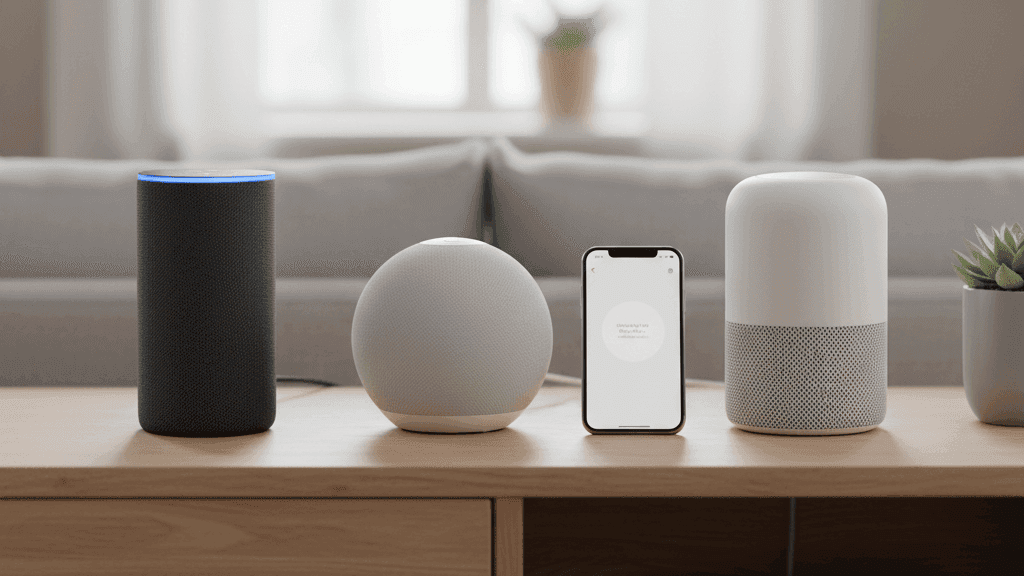
Choosing Your First Smart Speaker: Alexa vs. Google vs. Siri

Before I bought my first smart speaker, I spent about a week reading comparison articles and came away more confused than when I started. Every review had a different verdict. Some said Alexa was best for smart homes. Others argued Google Assistant was smarter. Apple fans were adamant that the HomePod was in a completely different league. None of these articles told me what I actually needed to know, which was: given my specific situation, which one should I get and why.
I have now lived with all three over the years, not simultaneously, but across different periods as my setup evolved. I have a fairly clear sense of where each one genuinely excels, where each one frustrates, and what kind of person is best served by each option. This is what those comparison articles should have said.
What a Smart Speaker Actually Does in a Real Home
Before comparing the three options, it is worth being clear about what role a smart speaker actually plays in a smart home, because the marketing tends to oversell certain capabilities while underselling the ones that matter most in daily use.
The primary function in a smart home context is acting as a voice interface for your devices and routines. You tell it to turn things on and off, trigger scenes, set timers, and run automations. This is what you will use it for dozens of times a day once you are set up, and it is the capability that varies most meaningfully between the three platforms.
The secondary function is general assistant tasks: answering questions, setting reminders, playing music, checking calendars. This is where the three platforms differ in the intelligence and naturalness of their responses.
The tertiary function is playing audio. All three can play music, podcasts, and radio. The hardware quality of the speaker matters here, though the entry-level devices from all three brands are designed primarily as smart home hubs rather than high-fidelity speakers.
Understanding the priority order of these three functions for your own situation will tell you more about which platform to choose than any direct feature comparison.
Amazon Echo and Alexa
I started with Alexa and I still use it as my primary setup, which tells you something about where I think it sits overall.
Alexa's defining strength is device compatibility. It supports a wider range of smart home devices than either Google Home or Apple HomeKit, and the integrations tend to be more complete rather than just technically present. When I have bought a new device and wondered whether it would work with my existing setup, the answer has been yes with Alexa far more consistently than with the other platforms. For someone building a smart home from scratch and likely to buy devices from multiple brands over time, this matters more than it might initially seem.
The routine-building system in the Alexa app has improved substantially over the past couple of years. You can create reasonably complex automations without needing technical knowledge, and triggers include time, voice commands, device states, and with some configuration, your phone's location. I have built routines in Alexa that I could not have replicated in the Google Home app because the trigger I needed simply did not exist there.
Where Alexa falls short is in general intelligence and conversational ability. Ask it a complex factual question and you will sometimes get a vague or incorrect answer. Follow-up questions without repeating the context tend to confuse it. If you are someone who wants to have genuine back-and-forth conversations with your assistant or use it for substantive research questions, Alexa will frustrate you.
The Echo Dot, which is the entry-level Echo device, is what I would recommend for most people starting out. It costs around $30 to $50, sounds fine for a hub device, and gives you full access to everything Alexa can do.
Google Nest and Google Assistant
Google Assistant has one capability that is genuinely ahead of both Alexa and Siri, and that is natural language understanding. It handles complex, multi-part questions better. It remembers context within a conversation so you can ask follow-up questions without re-stating everything. It draws on Google's search index for factual answers, which tends to produce more accurate results for obscure questions. If you talk to your assistant a lot and you want those conversations to feel less robotic, Google Assistant is noticeably better at this than the alternatives.
The integration with Google's own services is also genuinely useful if you are a Google services user. Calendar appointments read out correctly. Reminders sync with Google tasks. If you use Android and rely on Google's ecosystem for your personal organisation, the Nest devices slot into that naturally in a way that Alexa never quite manages.
The smart home control side is solid but narrower than Alexa. Google Home supports a large number of devices, but the list is shorter than Alexa's and some integrations that exist on Alexa are missing or less functional on Google Home. The routine building system, called automations in the current version of the app, has also historically been less flexible than Alexa's, though Google has been improving this actively.
The Nest Mini at around $50 is the starting point for the Google ecosystem. The Nest Audio is a step up in audio quality if sound matters to you. The Nest Hub adds a screen which is useful for viewing camera feeds and following along with recipes.
Apple HomePod and Siri
The HomePod and HomePod mini are the right choice for a specific kind of person: someone who is already deeply embedded in Apple's ecosystem, uses Apple Music, has an iPhone as their primary device, and cares significantly about audio quality.
Siri's smart home control through HomeKit is reliable and the privacy architecture is meaningfully different from the other two platforms. Apple processes most requests on the device itself rather than routing them through cloud servers, which appeals to people who are uncomfortable with the idea of their voice commands being stored remotely.
The HomePod mini produces genuinely impressive audio for its size. The original HomePod has some of the best sound quality available in a smart speaker, which matters if you are using it in a primary living space where you listen to music regularly.
The significant limitation is device compatibility. HomeKit supports fewer devices than either Alexa or Google Home, and for some device categories the selection is noticeably restricted. If you want to build a diverse smart home with products from various manufacturers, you will hit compatibility walls with HomeKit more often than with the other platforms. The newer Matter standard is helping with this, as Matter devices are compatible with HomeKit, but the gap in overall device selection is still real.
If you do not use Apple Music and do not have an iPhone as your primary device, there is essentially no case for buying a HomePod. The ecosystem lock-in is real and the benefits only exist within that ecosystem.
How to Actually Decide
The honest answer is that the right choice depends on what you already use and what you prioritise.
If building a smart home with devices from multiple brands is your primary goal, and you want the most flexible and compatible platform, Alexa is the safer choice. The device support is broader and the routine system is more powerful for home automation specifically.
If you talk to your assistant constantly and want it to function as a genuinely intelligent conversational tool, and you are already using Android and Google services, Google Assistant will serve you better day to day. The smart home control is good enough, and the conversational quality is the best of the three.
If you have an iPhone, use Apple Music, and audio quality is genuinely important to you, the HomePod mini is worth considering. Just go in knowing that your device options will be more limited.
One thing I would push back on gently is the idea that this decision is permanent and consequential. Changing your primary smart home platform later is inconvenient because you need to re-pair your devices, but it is not impossible and it is not a disaster. If you pick one, spend a year with it, and find that a different platform would serve you better, you can migrate. Starting somewhere and learning what you actually need from your setup is more useful than spending weeks trying to make the perfect theoretical decision before buying anything.
Pick the one that matches your current setup most naturally, buy the cheapest entry-level device, and start building. You will learn more from using it for a month than from any comparison article including this one.
I have used all three platforms at different points over four years of building smart home setups. My current setup runs on Alexa primarily, with a Google Nest Hub in the kitchen because I use it mainly for recipes and YouTube, which Google handles better.


