8 Smart Lawn Care Gadgets You Didn't Know Existed

Lawn care has a reputation as a meditative weekend activity for people who enjoy it and a recurring obligation for everyone else. I fall firmly in the second category. The hour spent pushing a mower in summer heat was never something I looked forward to, and the guilt of looking at an overgrown lawn mid-week when work kept me from dealing with it was its own minor annoyance.
Smart lawn care technology has improved enough in recent years that several products in this category genuinely deliver on their promises rather than just moving the same effort to a different form. This is what is actually worth knowing about and, more specifically, what is worth buying versus what is still more impressive in theory than in daily use.
Robot Lawn Mowers: The Category That Has Finally Grown Up
Robot mowers exist in two distinct eras. The pre-2020 versions required you to bury a physical boundary wire around the perimeter of your lawn, which was a significant installation project, and navigation within that boundary was somewhat random. They worked, but the setup effort and the random cutting patterns dampened enthusiasm.
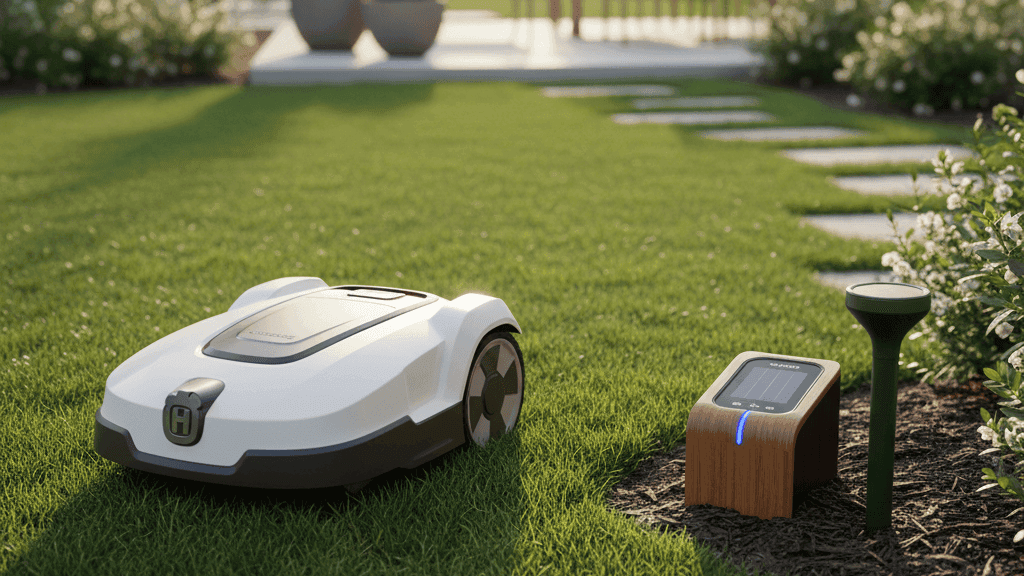
Current robot mowers from Husqvarna, Segway Navimow, and Worx Landroid use GPS or camera-based mapping to define and navigate your lawn without buried wires. You walk the boundary of your lawn using the app once during initial setup, the mower creates a digital map, and it follows systematic cutting patterns that cover the full area methodically rather than randomly.
The Segway Navimow uses RTK GPS for centimetre-level positioning accuracy. The cutting pattern follows straight, overlapping passes that produce a visually consistent finish comparable to manual mowing rather than the random circular marks that characterised older robots. Obstacle detection uses sensors to pause when something enters the mowing path, which handles the common concern about children or pets approaching the machine during operation.
The practical reality of living with a robot mower: setup takes a few hours for the initial mapping. After that, you set a schedule through the app and the mower handles the rest. It docks itself when the battery runs low and resumes when charged. The lawn is mowed more frequently than it would be manually, which generally produces better grass health at a lower cutting height than a weekly or fortnightly manual session. The noise level on premium models is genuinely low enough to run in the early morning without bothering neighbours.
The investment is significant. The payoff calculation depends on how much you currently pay for lawn care, whether professionally or in your own time. For large properties where manual mowing takes several hours, the time return is substantial and the payback period is relatively short.
Smart Irrigation Controllers: The Upgrade With the Clearest Financial Return
A smart irrigation controller that replaces your existing timer-based sprinkler controller is the lawn care technology purchase with the most consistent return and the clearest mechanism by which it saves money.
The fundamental problem with timer-based irrigation is that it waters on a fixed schedule regardless of actual conditions. A system set to water Tuesday, Thursday, and Saturday runs on Saturday morning whether it rained heavily on Friday or not. This wastes water, wastes money, and can actually harm grass health through overwatering.
The Rachio 3 connects to your home's Wi-Fi, downloads weather data for your precise location, and skips or adjusts watering based on current and forecast conditions. If rain is expected tomorrow, it skips today's scheduled watering. If it has been unusually hot and dry, it extends the duration. You tell it what grass type, soil type, and sun exposure each zone has, and it creates a schedule optimised for those parameters.
The installation replaces your existing controller, a process that involves matching the existing wires to the appropriate terminals on the Rachio and takes about thirty minutes for someone comfortable with basic electrical tasks. The Hunter Hydrawise and Orbit B-hyve offer similar functionality at different price points.
The water savings are consistently reported in the range of thirty to fifty percent by users who previously ran timer-based systems without rain sensors. At typical residential water rates, this pays for the controller within one to two growing seasons in most climates.
Soil Moisture Sensors: Closing the Loop
A soil moisture sensor buried at root depth adds a layer of direct measurement that complements the weather-based intelligence of a smart irrigation controller. Rather than estimating whether soil is dry based on temperature and rainfall data, the sensor measures actual soil moisture and can trigger irrigation based on that direct reading.
Paired with a smart controller, this creates a closed-loop system: water when the soil is actually dry, stop when it reaches adequate moisture. The benefits are most significant in situations where irrigation zones have varying sun exposure, drainage, or soil composition that makes uniform scheduling suboptimal.
The installation requires burying the sensor at the appropriate root depth, which varies by grass type, and connecting it to the irrigation system or hub. Battery-powered wireless sensors avoid the need for wiring runs across the garden but require periodic battery replacement. Several brands including Rachio-compatible sensors and standalone options from RainPoint integrate directly with major smart controllers.
For gardens where different zones have genuinely different moisture needs, the precision this adds is worthwhile. For more uniform lawns where the weather-based intelligence of a smart controller already provides good results, the marginal benefit is smaller.
Smart Hose Timers for Gardens Without Built-In Irrigation
The smart irrigation category is predominantly designed for homes with in-ground sprinkler systems. For gardens with hoses and surface sprinklers, smart hose timers provide similar scheduling and weather intelligence at a fraction of the cost and without any installation complexity.
A smart hose timer screws onto the outdoor tap and the hose connects to it. You control it through an app, set schedules, and on the better models receive weather-based skip recommendations similar to the full controllers. The Rachio hose timer extends their ecosystem to hose-based gardens with two-zone control.
This is the right starting point for anyone without an in-ground system who wants to automate garden watering without the investment of installing one. Renters, people with smaller gardens, and anyone who wants to test smart irrigation logic before committing to a full controller installation benefit from this approach.
Garden Sensors for Soil Health Monitoring
Beyond moisture, soil sensors that measure pH, nutrient levels, and light exposure give you direct information about the conditions your grass and plants are growing in rather than requiring you to observe symptoms after problems have already developed.
Products like the Parrot Flower Power and various agricultural sensors adapted for home garden use provide continuous monitoring of these parameters and alert you when readings fall outside optimal ranges. The practical value is highest for people who have had persistent lawn health problems and want to identify the underlying cause, or for kitchen gardens and plant-heavy outdoor spaces where individual plant health monitoring adds clear value.
For a lawn where your primary concern is keeping grass green and managed, soil sensors add information but the improvement over good observation and basic testing is incremental rather than transformative.
Robot Lawn Mowers for Smaller Gardens
The category of robot mowers covers a wide range of garden sizes, and the mid-range models designed for smaller properties have improved significantly in the past few years. If your lawn is under 500 square metres, the product range is broader and more accessible in price than it was even two years ago.
The Worx Landroid range, which starts at smaller capacities than the Segway and Husqvarna premium models, now includes wire-free navigation on newer models that brings the same setup simplicity to the budget tier. The cutting quality on these models is good enough for most residential lawns even if it does not quite match the line precision of the premium GPS options.
For a small, relatively obstacle-free lawn where the primary goal is consistent maintenance without manual effort, the mid-range robot mowers represent the best value proposition in smart lawn care technology.
The Honest Assessment
The smart lawn care products that have genuinely matured and deliver consistent value are the robot mower for anyone who dislikes mowing or pays for professional lawn care, and the smart irrigation controller for anyone with an existing in-ground system. Both have reached a level of reliability and ease of use where the technology works in the background as it is supposed to rather than requiring ongoing troubleshooting.
The sensor category is useful in specific situations but adds incremental value rather than transformative improvement for most homeowners. The more exotic applications, supplemental grow lighting for shaded lawns and AI-powered disease detection from aerial imagery, are still primarily professional and agricultural tools that are gradually becoming accessible to residential users.
Start with the irrigation controller if you have in-ground irrigation. The payback in water savings is clear and the installation is manageable. Add a robot mower if you have a large enough lawn that the time and energy investment of manual mowing is genuinely burdensome. These two changes cover the majority of the practical benefit that smart lawn care technology can offer a typical home.
The irrigation controller was the first smart garden purchase I made and the one I would recommend without qualification. The water savings were immediately visible in the utility bills and the lawn health improved because the watering was better matched to actual conditions rather than a schedule I set once and never adjusted.


