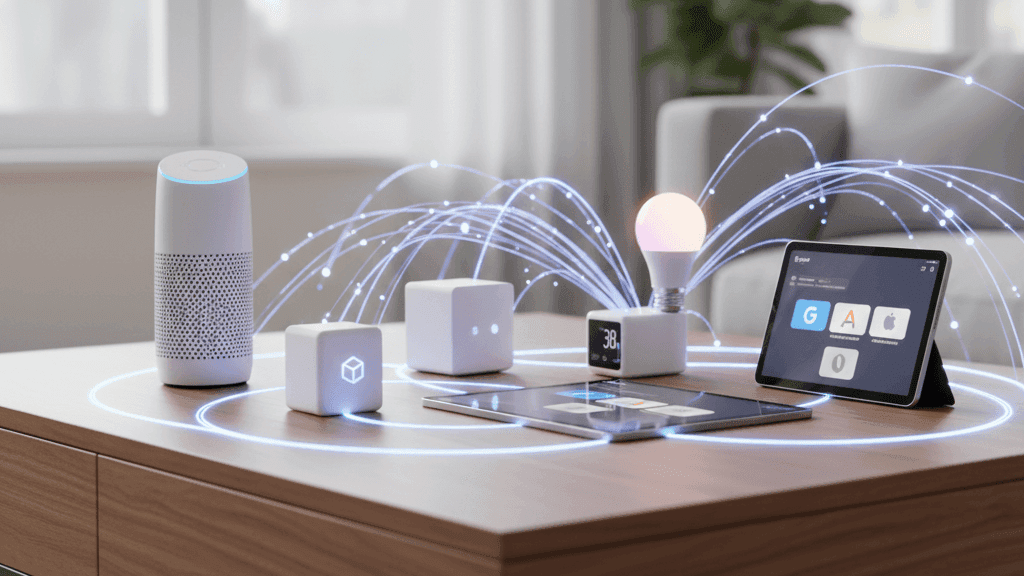
What is Matter? The New Language of Your Smart Home, Explained

For the first two years of building my smart home, the question I dreaded most when buying a new device was not "how much does it cost" or even "will it work reliably." It was: "does this actually work with what I already have?"
I would find a sensor I liked, read through the spec sheet, and then spend twenty minutes cross-referencing whether it supported Alexa, whether Alexa's integration for it was actually functional or just technically listed, and whether anyone on Reddit had gotten it to work with the hub I was using. Sometimes I would buy something, get it home, and discover that the integration existed in name only and the device basically only worked through its own app. I have a drawer with three products in it that ended up in exactly that situation.
The smart home industry spent about a decade creating this problem, and a standard called Matter is what the industry agreed on to fix it. If you have seen the word on product packaging recently and were not sure what it meant or whether it mattered for you personally, this is the explanation I wish I had had when I first encountered it.
Why Smart Home Compatibility Was Such a Mess
To understand why Matter exists, it helps to understand what the situation looked like before it.
Every major technology company in the smart home space built its own ecosystem. Amazon had Alexa and its own set of supported devices. Google had Google Home. Apple had HomeKit. Samsung had SmartThings. Each of these platforms spoke its own language, and smart device manufacturers had to decide which languages their products would support. Supporting all of them properly was expensive and technically complicated, so most companies picked one or two and left the others out.
This meant that as a consumer you were constantly checking compatibility before buying anything. A sensor that worked perfectly in an Alexa setup might do nothing useful in a Google Home setup. A bulb certified for HomeKit might not appear in the Google Home app at all. And if you had devices from multiple ecosystems, which most people ended up with by accident, getting them to trigger each other in automations ranged from difficult to impossible.
I once spent four hours trying to get a door sensor to trigger a routine in Alexa when the sensor was technically listed as compatible. The integration existed, but the specific trigger I needed was not supported. I found this out after buying the sensor, setting it up, and then hitting a wall in the automation builder. That sensor also lives in the drawer.
What Matter Actually Is
Matter is an open-source connectivity standard, which is a technical way of saying it is a shared set of rules that devices can follow to communicate with each other regardless of who made them.
It was created not by a single company but by an alliance of over 500 technology companies including Amazon, Apple, Google, Samsung, Philips, IKEA, and hundreds of others. The fact that companies who compete fiercely in every other area agreed to collaborate on this tells you how badly the industry recognised the compatibility problem needed solving.
Matter does not replace Alexa, Google Home, or Apple HomeKit. Those platforms still exist and still function the way they always have. What Matter does is sit underneath them as a foundation. Think of it this way: Alexa and Google Home are still the interfaces you use to control your home and the places where your routines and automations live. Matter is what allows the physical devices in your home to communicate reliably with all of those platforms simultaneously without any extra work from manufacturers or from you.
If a device has the Matter logo on the box, it can be added to your smart home and controlled through Alexa, Google Home, Apple HomeKit, and Samsung SmartThings all at once. You are not locked into one platform. You do not need to check compatibility lists. The logo is the compatibility guarantee.
What Thread Is and Why It Comes Up in the Same Conversation
When you read about Matter, you will often see Thread mentioned alongside it and it can be confusing because they sound like they might be the same thing. They are related but different.
Matter is the application layer, the set of rules about how devices communicate and share information. Thread is a wireless networking protocol, an alternative to Wi-Fi for how that communication physically travels between devices.
Thread is designed specifically for smart home use. It is low-power, which means battery-operated sensors and buttons can run for years rather than months. It creates a mesh network where every Thread device also acts as a relay for other devices, which means signal strength improves as you add more devices rather than degrading. And it operates locally, meaning Thread devices communicate with each other directly rather than routing everything through the internet, which makes them faster and more reliable during internet outages.
Not every Matter device uses Thread. Many still use Wi-Fi. But devices that use both Matter and Thread together represent the most capable and reliable smart home hardware currently available, and they are increasingly common in newer product lines from established brands.
Does This Mean You Should Replace Everything You Own?
No, and any article telling you otherwise is trying to sell you something.
Your existing devices continue to work exactly as they did before Matter existed. Nothing breaks, nothing becomes incompatible, nothing needs to change unless you want it to. Matter is about making future purchases easier and more flexible, not about making your current setup obsolete.
There is one nuance worth knowing though. Some existing devices, particularly those that connect through a hub rather than directly to Wi-Fi, are being updated through software to support Matter as a bridge. The Philips Hue bridge is a good example: it received a firmware update that made it a Matter controller, which means Hue bulbs connected to it can now appear natively in other platforms without you having to set up separate integrations. If you have devices with active firmware support from established manufacturers, it is worth checking whether they have added Matter compatibility since you set them up.
What This Changes When You Are Shopping
Before Matter, buying a smart device required checking three separate things: does it work with my voice assistant, does the integration actually function properly, and will it work with my hub if I have one. This was tedious and the answers were not always accurate even from the manufacturer.
With Matter, the check becomes simpler. Does this product have the Matter logo? If yes, it will work with your setup. If you use Alexa and the product is Matter certified, it will appear in Alexa. If your housemate uses Google Home on their phone, they can control it there too. Same device, both platforms, no extra configuration.
This is genuinely significant for households where different people prefer different platforms, or for anyone who wants the flexibility to switch platforms in the future without replacing all their hardware.
Where Things Actually Stand Right Now
I want to be straightforward about this: Matter is still maturing. The standard launched in late 2022 and has been expanding the device types it covers ever since. The initial release supported bulbs, plugs, switches, and sensors well. Cameras, doorbells, and more complex devices like robot vacuums took longer to be added to the specification and manufacturer support for those categories is still catching up.
The setup experience, while better than the previous chaos of individual app setups, is not yet as seamless as the alliance's marketing suggests. Occasionally you will encounter quirks, especially when adding a device to multiple platforms simultaneously. These issues are getting resolved with firmware updates and platform improvements, but going in with realistic expectations is better than going in expecting magic.
What is already true is that for the core device categories, bulbs, plugs, and sensors especially, buying Matter-certified products gives you noticeably more flexibility and a better setup experience than buying non-certified equivalents. That benefit is real and it is already worth paying attention to when you are shopping.
The Practical Takeaway
You do not need to rush out and replace your current setup. But from now on, when you are buying new smart home devices, the Matter logo should be on your checklist. It is not the only thing to look for, build quality, app reliability, and manufacturer support history all still matter in the ordinary sense of the word. But it is a meaningful indicator that the device will work with your existing setup and give you flexibility you would not otherwise have.
The smart home has been a fragmented, frustrating landscape for a long time. Matter is the most serious attempt the industry has ever made to fix that at a foundational level. It is not finished yet, but it is already making things noticeably better for people buying new devices, and it is going to continue improving as more manufacturers ship certified products.
I have been navigating smart home compatibility issues for four years, which is how I know both how bad it was before and how much genuine improvement Matter represents even in its current form.


