Soundbars vs Small Speakers: What Makes Sense in a Tiny Living Room?

When I moved into my current apartment, the television was the first thing I set up, and the built-in speakers were the first thing that annoyed me. Not because they were broken or unusually bad, but because modern flat televisions have no room for decent speakers inside them. The panels are thin, the drivers are small, and the sound that comes out reflects that. Dialogue sounded muffled and I was turning the volume up to levels that felt aggressive just to hear conversations clearly.
The question of whether to buy a soundbar or a pair of small bookshelf speakers for a compact living room turned out to be more nuanced than I expected when I started looking into it. I ended up going through both options across different apartments and have a fairly clear sense of where each one makes sense and where each one disappoints.
What You Are Actually Choosing Between
The comparison is not really soundbar versus speakers as complete categories. It is more specifically about two different approaches to improving television audio in a small room.
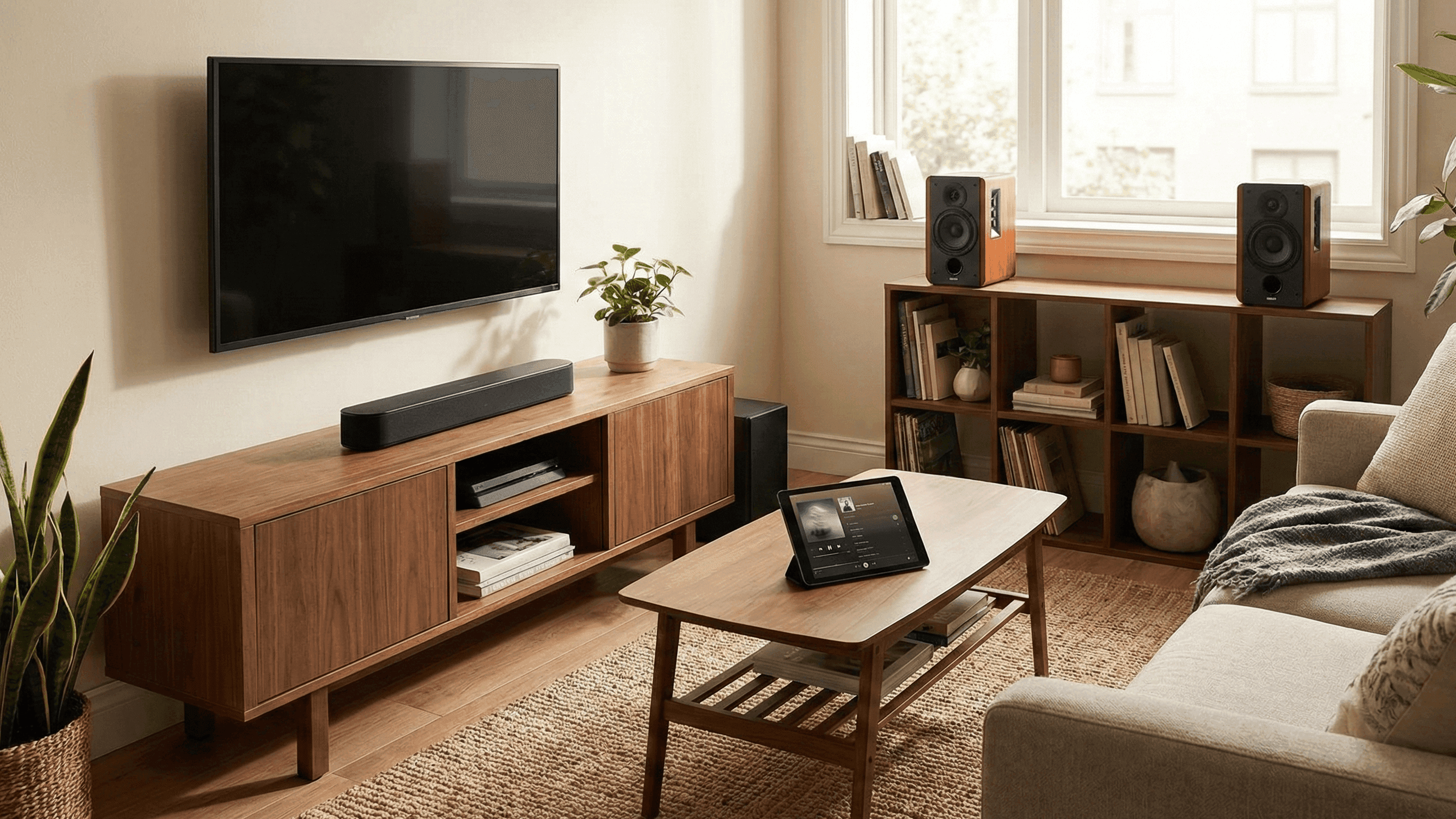
A soundbar is a single horizontal enclosure containing multiple drivers, placed below the television, that improves on TV speakers while maintaining a minimal footprint and simple cabling. Many include a separate wireless subwoofer. The whole system connects to the television with a single cable and is controlled through the television's remote via a feature called ARC or eARC on the HDMI connection.
Small bookshelf speakers, in this context, means a stereo pair of compact speakers, either powered with amplifiers built in or passive requiring a separate small amplifier, positioned on or near the television unit. These require more physical setup than a soundbar but produce a genuinely different acoustic result: two separate sound sources with a real physical distance between them, creating a stereo image that a single soundbar bar cannot replicate regardless of its processing.
Both are major improvements over television speakers. The choice between them is about which trade-offs suit your room and how you use it.
The Case for a Soundbar
The strongest argument for a soundbar in a compact living room is simplicity. Once it is in place, it works. The television remote adjusts the volume. Night mode, where available, compresses the dynamic range so that explosions do not dramatically exceed conversation volume, which is genuinely useful in apartments with neighbours. Dialogue enhancement, a common feature on most mid-range soundbars, makes speech clearer without requiring you to raise the volume.
The footprint is the other practical advantage. A soundbar sits under the television and the subwoofer goes beside the sofa. No additional stands, no cables running across the room to separate speaker positions, no decisions about placement angle. In a room where the furniture arrangement is already determined and there is limited flexibility, this matters.
The integration with modern televisions is also genuinely useful. Most televisions display a volume overlay when you use the TV remote to adjust soundbar volume. The soundbar turns on automatically when the television does. This makes the whole system accessible to anyone who knows how to use the television, without additional setup or explanation.
Where soundbars struggle is in creating a convincing stereo image. A soundbar is a single physical source, and regardless of what processing is applied to try to create the impression of width, it is still sound coming from one location below the screen. The effect for music in particular, where stereo separation is perceptible and meaningful, is noticeably less convincing than two separate speakers. For television dialogue and general programme audio the difference is less relevant, but if you use your living room audio for music listening as well as television, this matters.
The Case for Small Bookshelf Speakers
Two speakers positioned a metre or more apart create a stereo field that a soundbar cannot fully replicate. For music, this is immediately and consistently noticeable in a way that quickly becomes the thing you are reluctant to give up once you have experienced it. For films and television, the difference is less dramatic but still present: sound effects that should come from the left actually come from the left, and the spatial quality of well-mixed audio is more accurately reproduced.
The sound quality at a given price point is generally better from a pair of bookshelf speakers than from a soundbar at the same price. Speaker design and the acoustic physics of separate enclosures allow bookshelf speakers to produce fuller, more natural sound, particularly in the midrange frequencies where voices and instruments live, than soundbars of equivalent cost. If your budget is fixed and you are comparing equivalent price points, speakers tend to win on audio quality.
Upgradeability is a real advantage if you intend to stay in the same space for several years. A good pair of bookshelf speakers can be used with different amplifiers, moved to a desk setup if you reconfigure the room, supplemented with a subwoofer later, or paired with better equipment as your budget allows. A soundbar is largely a fixed system.
The practical disadvantages are real. More cables: from the television to the amplifier, and from the amplifier to each speaker. A separate amplifier or receiver, which is another box to house and power. More placement decisions: bookshelf speakers need to be at roughly ear height, positioned with appropriate distance from walls, and angled toward the main listening position for the best results. In a room where furniture placement is fixed and the speaker placement options are limited, getting the ideal positioning may not be possible.
Which One Actually Works Better in a Small Room
For most compact living rooms used primarily for television and casual movie watching, shared with other people who need to use the system without instruction, a soundbar at a reasonable price point is the more practical choice. It does the job, it does not require ongoing attention, it integrates with the existing television setup cleanly, and the limitations around stereo imaging are not particularly relevant for the primary use case.
For someone who listens to music as much as they watch television, who is comfortable with the additional setup requirements, and who values audio quality above convenience, a pair of bookshelf speakers with a small amplifier will consistently sound more satisfying. The setup takes more time and thought but produces a result that rewards repeated listening in a way a soundbar often does not.
The hybrid approach that I find myself recommending most often is a soundbar for television audio combined with a Bluetooth speaker for music. The soundbar handles the TV integration requirements simply and effectively. A separate, good-quality Bluetooth speaker placed anywhere in the room handles music playback with the convenience of wireless streaming from a phone. The two systems serve different use cases without competing with each other and the total cost is often similar to a premium soundbar alone.
Practical Setup Advice for Both Options
For soundbars, placement matters more than people assume. The soundbar should be as close to ear height as your setup allows. Placing it on a low television unit where it is pointing at your knees significantly reduces how well you can hear dialogue. The soundbar should be flush with the front edge of whatever surface it sits on, not pushed back under a shelf where the sound bounces off the shelf surface before reaching you.
Turn off virtual surround processing when you first set it up and listen to the natural stereo output for a week before deciding whether to re-enable it. Virtual surround processing can improve the sense of immersion for action films but often makes dialogue sound slightly diffuse and echoey in a small room with reflective walls. The base stereo mode tends to be cleaner and more accurate.
For bookshelf speakers, start with a simple equilateral triangle configuration: the two speakers should be approximately the same distance from each other as they are from your main listening position, and both should be angled slightly toward that position. This is the standard starting point and produces good results in most rooms. Adjust from there if the bass sounds boomy, which usually means the speakers are too close to a wall, or if the stereo image sounds narrow, which usually means they need to be pulled further apart.
Soft furnishings in the room, rugs, curtains, sofas, cushions, absorb the reflected sound that causes harshness and echo in small rooms. In a room with hard floors and bare walls, any audio system will sound worse than the same system in a furnished room. If you are evaluating speakers and the room is relatively empty, that is not the final test.
I currently have a mid-range soundbar in my living room for television, and a separate Bluetooth speaker that I use for music throughout the day. The combination handles both use cases better than either alone would.


